The Benefits of Custom Software vs. Off-the-Shelf Solutions
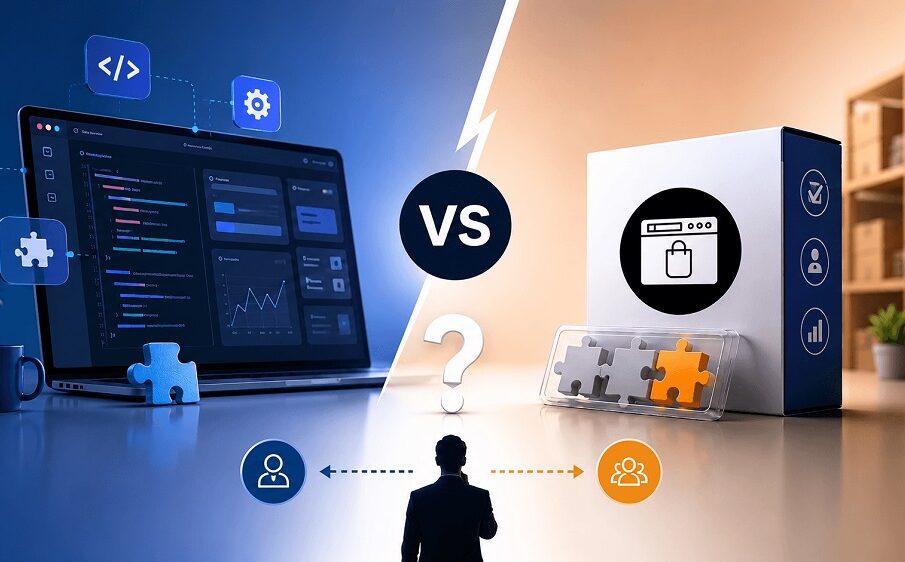
Every expanding business eventually reaches a critical technological crossroads: should you invest in bespoke custom software built specifically for your unique operations, or implement a pre-built, off-the-shelf software package? Selecting the right software architecture directly impacts operational efficiency, financial scalability, employee productivity, and long-term competitive positioning.
While commercial off-the-shelf software offers rapid initial deployment and lower upfront costs, it often forces companies to alter their core business workflows to fit rigid, pre-programmed software templates. Conversely, custom software requires a higher initial financial commitment and a dedicated development timeline, but it delivers complete operational alignment, seamless integration capabilities, and proprietary competitive advantages.
Evaluating the structural differences, financial trade-offs, and long-term strategic impacts of both options helps organizations select the optimal software approach for their unique growth trajectory.
Understanding Custom Software and Off-the-Shelf Solutions
Before comparing operational benefits, it is essential to define how these two software models function within an enterprise environment.
Custom Software Solutions
Custom software, also referred to as bespoke or tailored software, is designed, built, deployed, and maintained exclusively for a specific organization. The software development lifecycle begins with an in-depth analysis of the company’s unique operational processes, data workflows, user roles, and business goals.
Because the organization holds full ownership of the intellectual property and source code, custom software can be modified, expanded, and integrated with other systems whenever internal requirements change, without relying on external vendor roadmaps.
Off-the-Shelf Software Solutions
Off-the-Shelf software consists of pre-packaged commercial applications engineered for mass-market distribution. Designed to serve a broad spectrum of businesses across various industries, these tools offer standardized feature sets for common operational functions like accounting, customer relationship management, project tracking, and inventory management.
Users typically license the software through monthly or annual Software-as-a-Service subscription models, accessing the platform through cloud infrastructure maintained by the software vendor.
Operational Flexibility and Workflow Alignment
The most fundamental distinction between custom and pre-built software lies in how closely the technology mirrors your day-to-day business operations.
Tailoring Technology to Fit Business Processes
Off-the-shelf software is built for the average user, meaning it must cater to thousands of different companies simultaneously. Consequently, commercial software includes a vast array of generic features while lacking specialized tools designed for unique operational niches. Businesses using off-the-shelf tools often find themselves adapting their efficient internal procedures to match the rigid constraints of the software.
Custom software flips this dynamic entirely. Tailored applications are built around your existing, proven business processes. Every interface, button, database field, and automated workflow is engineered to match how your team works best, eliminating unnecessary operational friction and preserving your company’s unique operational strengths.
Eliminating Bloatware and Feature Fatigue
Commercial software packages frequently bundle hundreds of complex features intended for diverse market segments. Most organizations utilize only a small fraction of these capabilities, yet employees must navigate cluttered dashboards, confusing menus, and irrelevant settings daily.
Custom software delivers a clean, streamlined user experience containing only the exact tools, reports, and interfaces your team requires. This targeted design reduces training time for new hires, minimizes human error, and accelerates daily execution speed across departments.
Financial Considerations: Total Cost of Ownership
Comparing the financial impact of custom software versus off-the-shelf solutions requires looking far beyond initial implementation invoices to analyze long-term Total Cost of Ownership.
Upfront Capital Investments versus Recurring Operational Costs
Off-the-shelf software features low initial entry costs. Organizations can purchase subscriptions and onboard users within days for a modest monthly fee per license. However, as the business scales and adds dozens or hundreds of employees, recurring user license fees compound dramatically year after year.
Custom software requires a substantial upfront financial investment to fund initial architecture design, software engineering, testing, and deployment. However, once the application is deployed, the business owns the platform outright, eliminating recurring per-seat user licensing fees forever. Over a five to ten-year operating horizon, custom software often proves far more economical for growing enterprises than compounding subscription tiers.
The Hidden Costs of Off-the-Shelf Software
While pre-built software appears cheaper initially, hidden operational expenses frequently emerge over time:
-
Subscription price increases: Vendors can raise monthly subscription fees or alter licensing tiers at their discretion.
-
Workaround expenses: Staff members spend valuable hours manually transferring data between incompatible commercial tools.
-
Costly custom add-ons: Attempting to force a commercial platform to perform specialized tasks often requires purchasing expensive third-party plug-ins or hiring specialized consultants.
-
Paid feature upgrades: Essential advanced tools are frequently locked behind high-cost enterprise subscription tiers.
System Integration and Data Architecture
Modern businesses rely on dozens of software applications to manage sales, finance, human resources, and supply chains. How smoothly these systems communicate determines enterprise efficiency.
Seamless Third-Party Integrations
Off-the-shelf software applications often feature limited integration capabilities. Vendors construct closed ecosystems or offer basic application programming interfaces that connect only with select partner tools. When a commercial platform cannot connect directly to an existing database, employees must manually re-enter data, creating operational bottlenecks and data discrepancies.
Custom software is engineered specifically to connect with your entire legacy IT infrastructure. Developers build custom APIs and data pipelines that connect hardware systems, proprietary databases, and third-party tools into a single cohesive network, ensuring real-time data synchronization across your enterprise.
Complete Ownership of Data Assets
Data is one of the most valuable assets a modern business possesses. When using commercial SaaS platforms, your corporate data resides on third-party servers governed by the vendor’s data access policies and security protocols. Migrating historical data off a commercial platform if you decide to switch vendors can be complex and expensive.
With custom software, your company maintains absolute ownership and control over all database architecture and historical records. Data can be stored on-premises or within private cloud environments, allowing you to control access permissions, backup schedules, and privacy compliance fully.
Scalability and Long-Term Strategic Advantage
As market conditions evolve and customer demands shift, your software technology must adapt alongside your organization.
Unrestricted Technological Scalability
Growing businesses frequently outgrow commercial software. When a pre-built platform hits its user limit, storage cap, or transaction processing ceiling, the business faces a painful software migration process, interrupting daily operations.
Custom software scales infinitely alongside your business growth. Because you own the codebase, your internal team or development partners can add new modules, expand database capacity, update user roles, and integrate emerging technologies like artificial intelligence whenever market opportunities arise.
Building Proprietary Competitive Advantages
Using the exact same off-the-shelf software as your direct competitors makes it difficult to differentiate your service delivery. If every firm in your industry uses the same commercial CRM or project management platform, your operational capabilities and customer experiences remain functionally identical.
Custom software serves as a strategic competitive moat. Proprietary algorithms, automated client portals, unique analytics dashboards, and streamlined fulfillment tools allow you to deliver faster, more responsive, and higher-quality service than competitors relying on generic market software.
Making the Right Choice for Your Enterprise
Deciding between custom development and commercial software requires a clear, objective analysis of your current organizational state and long-term strategic vision.
-
Choose Off-the-Shelf Software if: Your operational processes are standard across your industry, your budget is limited, you need immediate deployment within days, and you lack the internal resources to oversee software development.
-
Choose Custom Software if: Your business relies on unique, proprietary workflows, you want to eliminate recurring per-user licensing fees, you need to unify incompatible legacy systems, and you view technology as a primary competitive differentiator.
Frequently Asked Questions
How long does it typically take to develop a fully custom software application?
Development timelines vary based on system complexity, required integrations, and scope. A basic custom application or minimum viable product usually takes three to six months to build, while complex enterprise systems with advanced workflows and extensive data integrations may require nine to eighteen months of engineering.
What happens if the software development company that built our custom platform goes out of business?
Because your business owns the intellectual property, full source code, and technical documentation of a custom build, you are never locked into a single software vendor. Any qualified software engineering firm or internal development team can review the source code, take over application maintenance, and build new features.
Is custom software more vulnerable to cybersecurity threats than commercial software?
Not necessarily. While major commercial software vendors invest heavily in security, their mass-market popularity makes them high-profile targets for cybercriminals seeking to exploit a single vulnerability across thousands of businesses. Custom software benefits from security through obscurity; its unique codebase is not publicly accessible, and developers can implement custom encryption, access controls, and private cloud hosting tailored specifically to your security protocols.
Can a business start with off-the-shelf software and transition to custom software later?
Yes, many growing businesses begin with commercial software tools to keep startup costs low while validating their market. As operations expand and commercial tools create bottlenecks, organizations harvest user feedback from their staff, map out exact functional gaps, and use those insights to build a custom application tailored to their mature workflows.
What are the ongoing maintenance requirements for custom software?
Like any physical asset, custom software requires ongoing routine maintenance. This includes applying security patches, updating server operating systems, optimizing database performance, updating third-party API connections, and making minor feature enhancements as business needs evolve. Organizations usually retain their development partner on a retainer or utilize an internal IT team for continuous maintenance.
How do low-code or no-code platforms fit between custom and off-the-shelf software?
Low-code and no-code platforms represent a middle ground, allowing businesses to build custom visual interfaces and automated workflows using pre-built software blocks with minimal traditional coding. While low-code platforms offer faster development than fully custom builds, they still carry platform licensing fees and technical limitations compared to custom software built from scratch.
How can a company accurately calculate the ROI of investing in custom software?
Calculate return on investment by estimating hours saved per employee through automated workflows, calculating the elimination of annual recurring SaaS licensing fees, measuring error reduction costs, and projecting revenue growth enabled by faster service delivery and unique competitive features over a five-year period.